

The history of the center of SP is a direct reflection of the history of the city and part of the history of Brazil. Living in the center is in contact with it at every corner. It is a street, a square, a shop, that makes us go back in time and experience what our ancestors built and left as a legacy.
What few people know, and what was not learned in school, is that the great São Paulo is an essentially indigenous and black territory. Yes, the native peoples lived in this region, and so we have places called: Anhangabaú, Ibirapuera and Ipiranga, and so on. And then, with the coming of enslaved African blacks, the city began to have not only black names, but a new design, and an energy and history of resistance.
Historic neighborhoods and buildings we know, churches like the Sé, were raised by black and indigenous hand, and we found traces of these peoples in architecture, design, drawings, and every brick placed in the buildings. So, in today's text, I want to bring 03 black places for you to know, revere your ancestry and realize that living and making the center a neighborhood of residence is a matter of history and respect.
History of the center of SP passes through Freedom
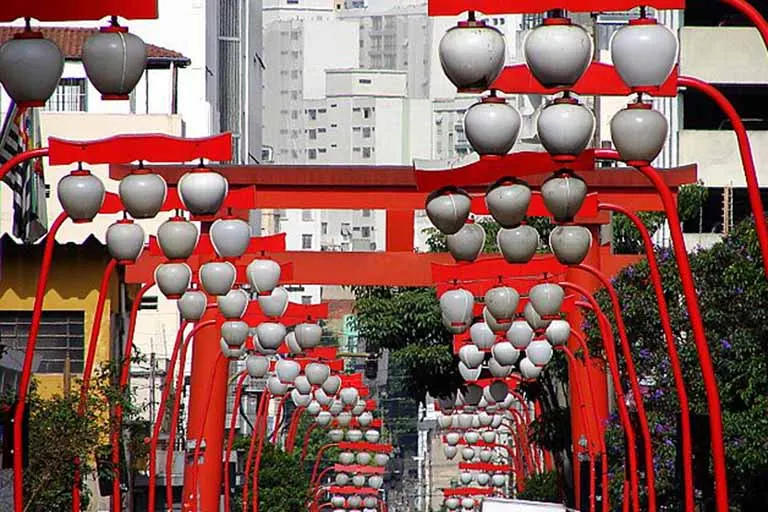
Known as the Japanese culture district, with bank and plates in Japanese language, uglies, temples, restaurants that revers Japan and the immigrant people who came to Brazil, the true history of Freedom is black. It is even a beautiful encounter of the name with the past.
Before being a commercial place, the Liberty District was a region of the Cemetery of the Afflicts, where black, indigenous and hanged people were buried. Chaguinhas before becoming a saint, was killed by sticks and buried in this cemetery. The relatives, the people who lived in the territory, also black and indigenous, started lighting candles on the site, and then the Church of Santa Cruz das Almas dos Engados emerged in 1853. The Chapel of the afflicted was also a presence, and in it people made the so-called “sympathies”, which are in fact popular and ancient wisdoms, in which they named someone under a wood and beat three times.
Today, there is a struggle in the field of law for the construction of the Centro de Referência da Memória Negra Paulistana, trying to prevent commercial works in the cemetery region and chapel, where were found 09 black bones of the nineteenth century. In addition, collectives and members of the Chapel of the Afflicts, continue trying to restore the place.
The process of Japanese immigrants coming to São Paulo, and the incentive for the occupation of the territory of Liberdade, one of the first peripheries of São Paulo in the central region, was of political background: the State wanted the whitening and erasure of black culture in the place, thus enhancing the rooting of Japanese culture. Which, in the end, is also part of a process of resistance, but here we must recognize the plurality of the Liberty Quarter and not allow this erasure.
Therefore, by living in the center and making a place more bairrist than commercial, we are also helping in the struggle of the black people to bring this historical, cultural and community essential to the economic power of the country, which at every moment seeks to flatten what has actually happened in the past, and what happens today in the present.
When you go to Freedom, don't forget that before Japanese lights – which are beautiful, I love – there was a pillory, a place of public violence of black bodies, a Chapel, a cemetery, finally, an entire architecture that was not only of pain and suffering, but also of spirituality and resistance.
A Our Lady Church of the Rosary of Black Men
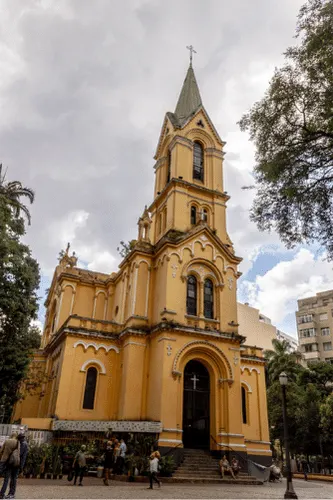
Leaving a little of the blue line, Freedom station, and going to red line, Republic, we will search the history of the Church Our Lady of the Rosary of Black Men.
This church is opposite the Olido Gallery - a cultural hub that is very important for hip hop culture – behind the Rock and Reggae Gallery – where you can do tattoos, by piercing and dread at a comrade price. The name is Largo Paiçandu. It is a big yellow construction with a monument of Black Mother at the entrance and is in the heart of the history of the center of SP.
The church reflects one of the facets of the black struggle for dignity and respect in the city of São Paulo, but also in Brazil. It retrieves the stories of the brotherhoods, the union of Catholic black people who worshiped Catholic saints united with the Bantu matrix – one of the black people who came enslaved to the Americas. These cults and rituals brought together as many hymns as drums, and are present throughout the national territory.
The church was consecrated in 1903, after the urbanization process of Mayor Antônio Prado demolished the first Church of Our Lady of the Rosary of Black Men in the region of Antônio Prado Square. It was built collaboratively by black people, between 1721 and 1722.
The brotherhoods besides a form of resistance, were also a black spiritual circuit in São Paulo. The church of Paiçandu, is dependent on the first church, the Parish Church of Santa Efigênia, created by a Catholic Nubia princess.
The figure of the mother is also important in this story. Black women, historically, lead and are the family base of all African culture. They were also milkmaids, and one of the first literacy teachers in Brazil. Therefore, the sculpture of the Black Mother faces the church Our Lady of the Rosary of Black Men, has an immeasurable symbolic value. The sculpture was made by Julius Guerra in 1955, all carved in bronze.
It is worth going to light a candle in the Church and to revere who came before, besides knowing more deeply the history of the city of São Paulo.
Municipal Theatre – a story in AmarElo
It is difficult to find someone who has not seen the film “AmarElo – it is all for yesterday”, a documentary by the singer and composer Emicida, in partnership with Netflix, which recovers the history of the artist’s career, joining with the struggles of black people in the central region of São Paulo. This is because the show of the album AmarElo, by Emicida, was at the Municipal Theatre, a place that in the social imaginary was always made for the elite, but that was actually raised by black hand.
In the documentary, Emicida brings the importance of being a black man doing a show on a stage historically reserved for white artists, and that this movement of hers, caused black people to occupy the audience and could celebrate themselves at the Theatre.
The stairs of the Municipal Theatre are the scene of much struggle of the Unified Black Movement, which resisted the dictatorship, built racial quotas policies, began to fight against the genocide of the black youth, and cried to all Brazil that black people have always organized themselves for freedom.
The Theatre, designed by Azevedo Branches, is part of the history of the center of SP and was inaugurated in 1911. It was the stage of Modern Art Week, in 1922, a milestone in Brazilian visual art. Modernism has recovered the colonial history of Brazil, and in many ways, has made the heritages of African and indigenous matrix central in our culture.
By the way, have you ever imagined living in a building designed by the Azevedo Ramos? unit in the Palacete Mococa!
Of course, the construction of the theatre was made in the light of European architecture and the wishes of the opera listening elite. So much so that the first show was a Shakespearean Hamlet opera. And so it was maintained the structuring racism of architecture, culture and the city, making that whoever had built this monumental very important for the territory, could not enter or present himself.
In addition to AmarElo, who occupied the Municipal Theatre, we had the opening of the Hip Hop Month in 2020, before the pandemic, with black, indigenous and favela figures show of importance for black culture and resistance. One of the main shows was Rincon Sapiência, rapper of the east! But what I loved most was my friend’s Gabi Nyarai (Listen to her here at Spotify!)Creator of the Battle Domination – it has a text of mine that talks about the battle. Gabi made the entire audience of the Theatre – black and peripheral, singing and dancing, exalted what place black is also in an opera house.
Want to know more about the center? Take a look at the other texts of our blog
