

Have you ever heard of the People's House? Specials in the centre- What's worth checking out!
Days ago I had to go to Dr. Light consultation, which is about 10 minutes from home, when there is traffic, about 15 minutes. I decided to go from uber on account of the pandemic. In the race of the return, I caught a driver who welcomed me with the following sentence: “Do you live here? Your neighborhood has a lot to do. One day it will be a good place”. At the same time I got angry with his vision of the center.
In another race, a driver was also surprised by the fact that he lived in the center, with this phrase: “Our, I always saw the center as a commercial place, What's it like living here?In both situations, I did not know what to answer, but I was very thoughtful about how the resumption of the center needs to be with another look: living here, humanizing this place, caring for this place and honoring an ancestral territory.
The neighborhood of Bom Retiro, where I live, is considered a low center. Often seen as old on account of the historic buildings, apartments of the 1960s, has a confluence of numerous cultures. Taking a walk you meet people of Oriental, Asian, Armenian, African, Italian... and so on.
Do you also like the idea of living downtown? Come take a look at our kitnets!
And in one of these streets, in Três Rios 252, there is the People's House. It is, a house of ours, of the people of the center of São Paulo, which together mobilizes to send a place of culture, art and urban aesthetics, as well as political actions.
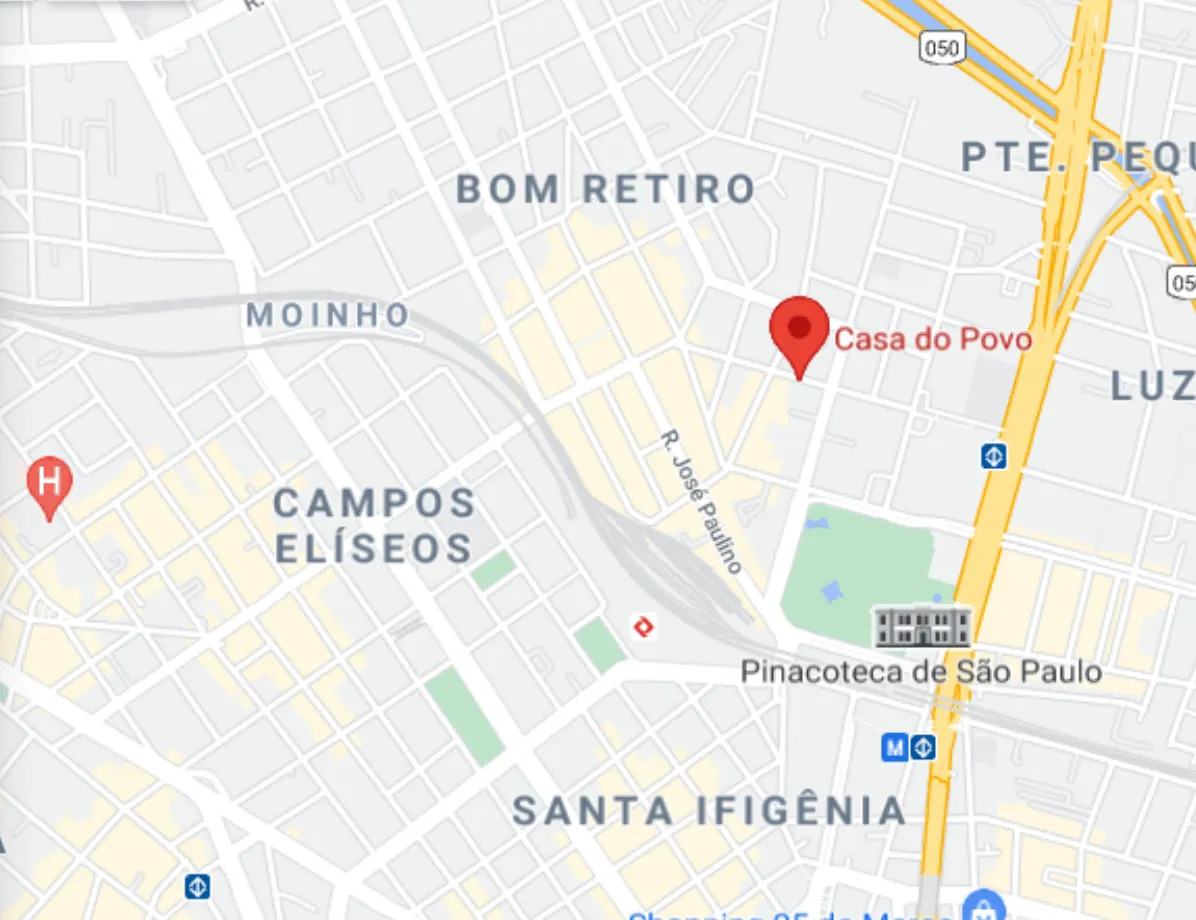
The People’s House – How does it work?
Founded in 1946, as a non-profit association, the People's House had as his first progressive Jewish owners from Western Europe, who and lived mostly in the Bom Retiro. The aim of the People's House was to honor the dead by fascism, and to honor the struggles here in Brazil for the end of Nazism, becoming a living organism. And this organism gained a body by building a modern, huge and very large building, with 03 floors and different spaces. In 1956 the House was opened with a ball and lots of food!
In 1980, the People's House faced an institutional and financial crisis, which followed the decline of the center of São Paulo. But in the late 2000s, it was reconfiguration. Now, not only would Jewish people be considered and valued within the House, but all and all who fight for the end of fascism, racism, machismo and so many other prejudices existing in Brazil and the world.
The New People's House
Today, the proposal of the People's House is to move the scene of theatre, dance, gastronomy, cinema, visual art and many other artistic and cultural aspects.
I want to rescue here the show When Burns Break, from Collective Occupation, a theater company founded by students and students who occupied public schools between 2013, 2014 and 2015. The Collective brought another look at the theater, building a play that portrayed not only the historical movement of students, but also the feelings, discoveries, frustrations of being leading a youth uprising in Latin America.
The play When Quebra Queima was presented numerous times in the People's House, precisely because of this political and territorial openness. Clearly, not all actors and actresses lived nearby, in Bom Retiro, however it was in the center of São Paulo that the struggle for a democratic quality education was established.
The day you went to watch the play, I remember the first crowded floor. Almost 200 people waiting for the first call from the theater to come up and watch the play. The staircases of the People's House occupied by strange and well-known people, fighting companions, movement and life.
The piece begins on the House Theatre floor. The wooden floor, the chairs scattered throughout the space and without stage. All space is stage, because the entire People's House is horizontal, without ups and downs, or some kind of hierarchy.
The People's House and journalism: for more diversity
My favorite place in the People's House is the ÉnoisWithout big bulldozers, it is one of my favorite places for proposing more diverse and representative journalism. I work at Énois as community coordinator, and the choice of being in the People's House is beyond budget, politics.
Énois is on the third floor, on the terrace. It is a space with a kitchen, and two working rooms, which during the pandemic foot period, was filled with young people planning a new future of journalism. The terrace was a bonus, where they went to have a coffee, smoke a cigarette, breathe a fresh air and enjoy the great São Paulo.
In the main room of the Énois has a giant window, which shows a full view of buildings. When I went to work the first time in the Énois, what enchanted me most was the view. It is only possible to draw new plans when you have a horizon, a wide view, the outside of the window.
Well, but recap, Énois is a non-profit organization, which was born as the School of Journalism (EJ), and was the first journalism school focused on youth and people from the periphery, reaching about 4,000 people with the project, which lasted from 2015 to 2019. Prior to 2015, directors Amanda Rahra and Nina Weingrill taught journalism and communication in other alternative spaces, such as the Zezinho House, Capão Redondo, outskirts of São Paulo and Casa Armenia, right here in the center.
Today the team of directors is also composed by Simone Cunha, and we are a Journalism Laboratory, which seeks to create strategy, methodology and tools to build and drive a more diverse journalism. These tools come from our training processes, which affect the whole of Brazil, from north to south, from the programs of writing exchanges and incidences in large media, as in Folha de São Paulo.
The existence of the Énois in the People's House is recent, but very significant. As I said, it is a democratic space, in which everyone can enter, leave and meet. Our space has no luxury, but it has everything we need: slates, chairs, internet and books. We receive and communicate with people through the democratic environment of the People's House.
Wow, a lot of things go through this space-temple, right? But I think the most important thing in this text is that being at the center is to embrace more and more that this territory is ours and deserves to be valued as a place that generates and maintains life, not just employment, money and power. The People's House was fundamental in the pandemic, distributing masks, food and providing workshops for income generation. It's these bridges we need to keep protecting the center. Oh, it's also there that some are organized. FICA activities- Just check it out.
Want to know more about the center, culture and diversity? Come take a look at the other texts of Our blog!
